Football Formations Explained: 4-3-3 vs 4-2-3-1 vs 3-5-2 – Which Tactical System Works Best?
SevensSportsArena
0 comments
Football is often described as "the beautiful game," but beneath the excitement of spectacular goals and breathtaking skill lies a tactical battle that many supporters never fully notice.
Every successful team, from Manchester City to Real Madrid, Barcelona to Inter Milan, is built around a carefully planned system designed to maximise its strengths while limiting its weaknesses.
Those systems are known as formations.
When commentators mention a team lining up in a 4-3-3, 4-2-3-1 or 3-5-2, they are describing much more than where players stand before kick-off.
A formation shapes how a team attacks, defends, presses, creates chances and controls possession throughout a match.
While managers frequently adjust tactics during games, understanding the basics of these formations helps explain why some teams dominate possession, others rely on quick counter-attacks and some prefer defensive solidity.
In this guide, we'll break down three of football's most popular formations, explaining how they work, their strengths and weaknesses, and why many of the world's best managers continue to rely on them.
Understanding Football Formations
A football formation is the starting arrangement of a team's outfield players.
The numbers represent defenders, midfielders and forwards from back to front.
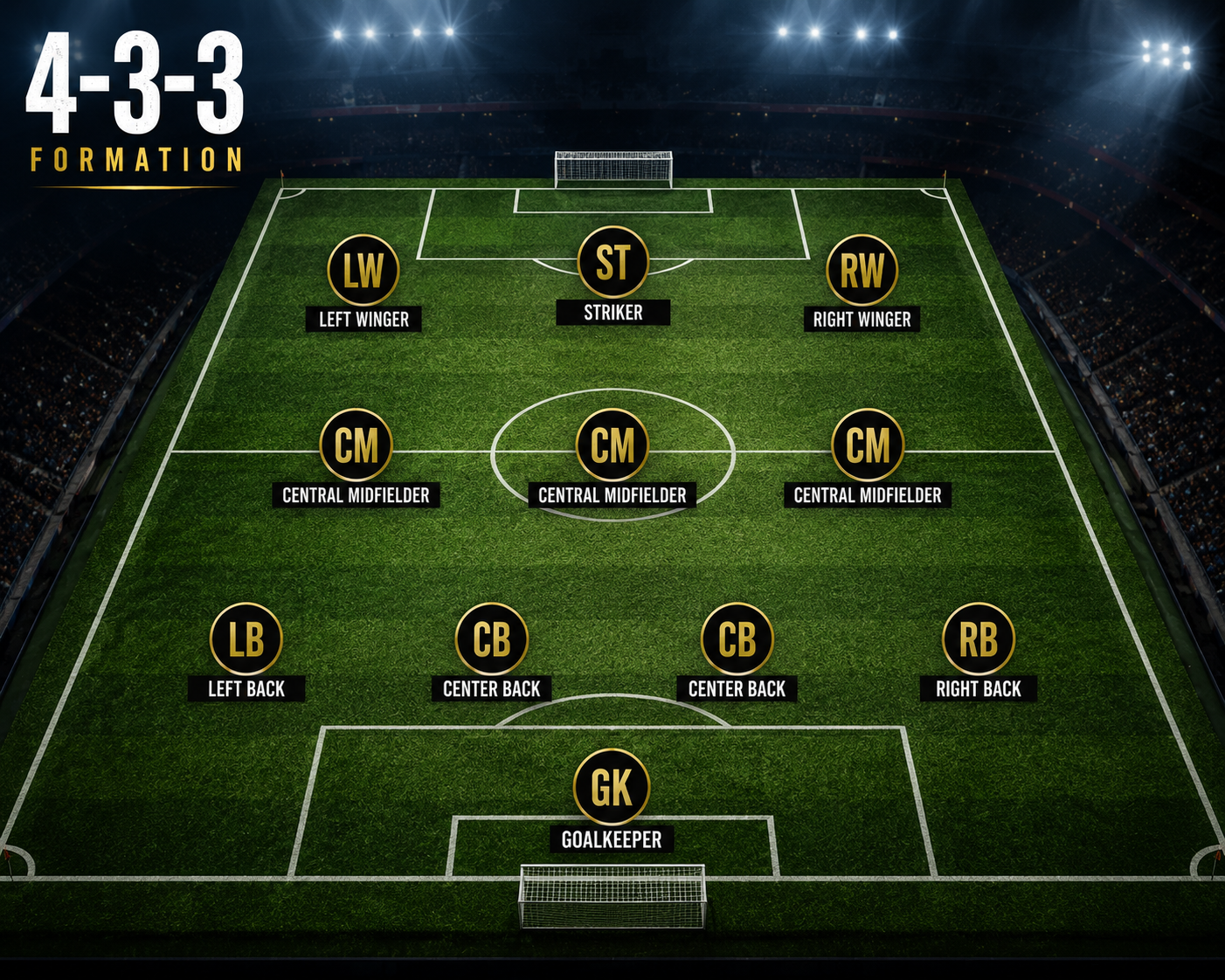
For example, a 4-3-3 means:
4 defenders
3 midfielders
3 forwards
It does not include the goalkeeper, who is always counted separately.
It's important to remember that formations are flexible. A team may defend in one shape and attack in another. For instance, a side that starts in a 4-3-3 may quickly transform into a 2-3-5 while attacking or a compact 4-5-1 when defending.
Modern football is less about fixed positions and more about movement, but formations still provide the foundation for every tactical plan.
The Evolution of Football Formations
Football formations have not always looked the way they do today. In fact, during the late 19th century, teams were almost entirely focused on attacking.
One of the earliest recognised systems was the 2-3-5, often called the "Pyramid", which featured five forwards. Defending was considered secondary, and high-scoring matches were common.
As the game became more organised and tactical, coaches realised they needed greater defensive balance. This led to the development of new systems that gradually reduced the number of attackers while strengthening midfield and defence.
Many of today's formations can trace their roots back to these early tactical experiments.
The evolution of formations reflects football's constant search for balance between attack and defence, creativity and discipline, possession and counter-attacking football.
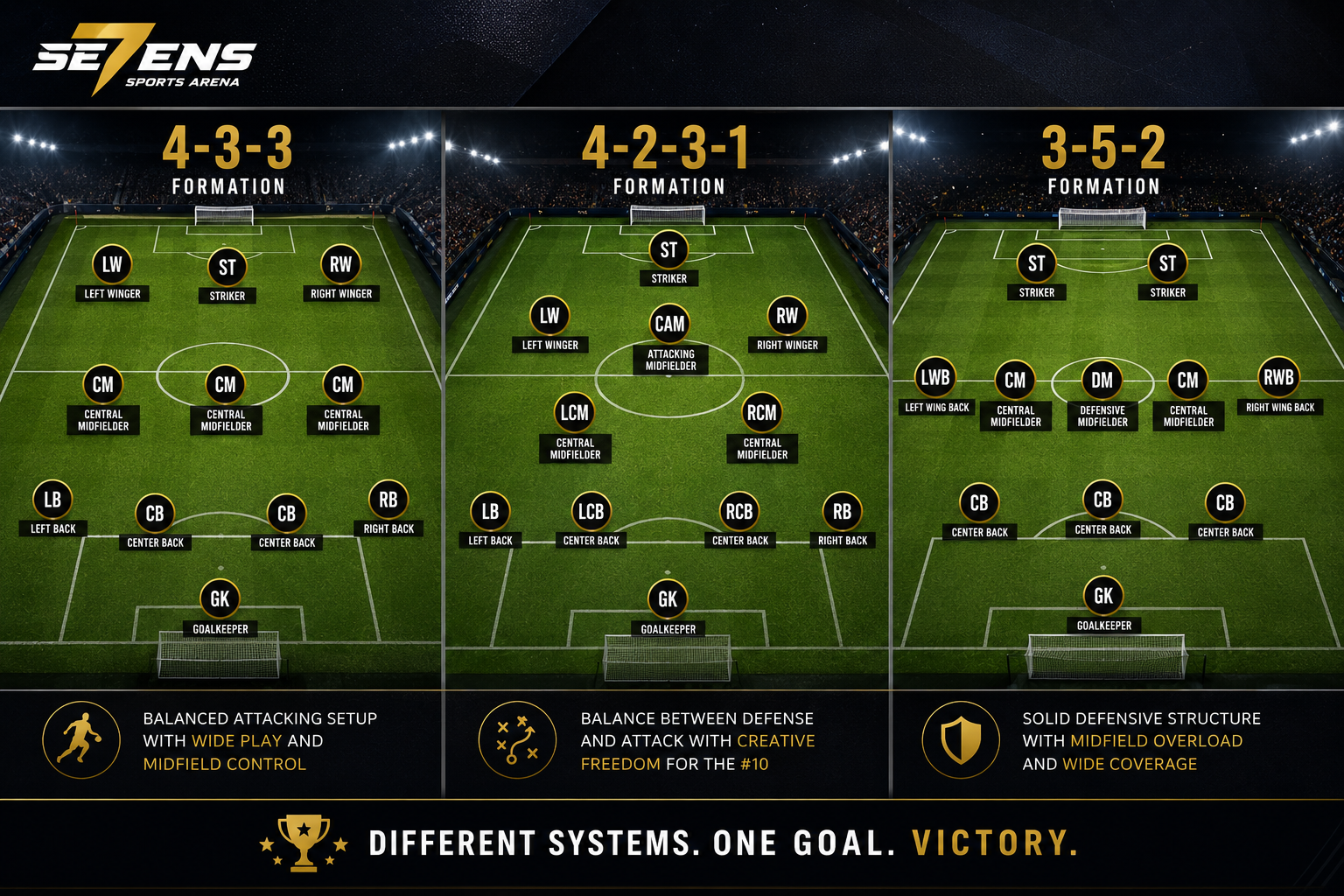
The 4-3-3 Formation: Built for Attacking Football
The 4-3-3 is one of the most recognisable systems in modern football and has been used successfully by legendary managers including Pep Guardiola, Jürgen Klopp and Luis Enrique.
The formation features four defenders, three midfielders and three attackers, usually consisting of a central striker flanked by two wingers.
Why Managers Love It
The biggest advantage of the 4-3-3 is width. With natural wingers stretching the opposition, teams create more space for midfielders and full-backs to operate.
This system also allows teams to press aggressively high up the pitch, making it difficult for opponents to build attacks from the back.
Possession-based football thrives in a 4-3-3 because the three midfielders can dominate central areas while the front three constantly threaten the opposition defence.
Weaknesses
●The formation demands enormous work rate.
●Wingers must help defend, midfielders cover large areas and full-backs often push high, leaving space behind them.
●If the midfield loses control, the team can quickly become exposed during counter-attacks.
Famous Teams
●Barcelona under Pep Guardiola
●Manchester City under Pep Guardiola
●Liverpool under Jürgen Klopp
●Spain's national team during their golden era
The 4-2-3-1 Formation: The Perfect Balance
Many coaches consider the 4-2-3-1 to be football's most balanced formation.
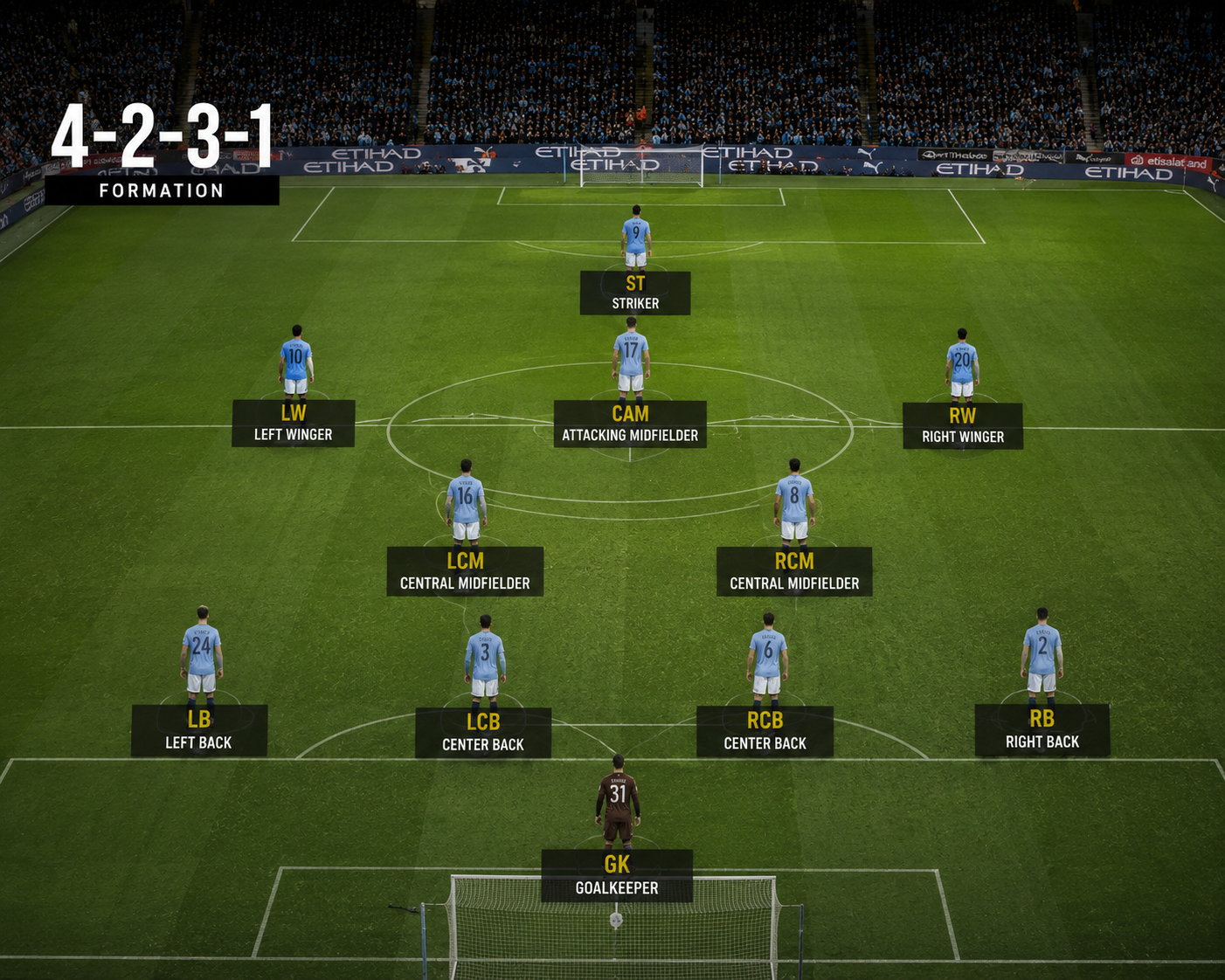
Instead of three central midfielders, this system uses two holding midfielders sitting behind an attacking midfielder, creating greater defensive stability while maintaining attacking creativity.
Why It Works
The double pivot protects the defence, allowing full-backs to attack with greater confidence.
The attacking midfielder becomes the team's creative engine, linking midfield with the striker while supporting attacks.
Wide players can either stay close to the touchline or drift inside depending on the manager's tactical plan.
Because of its balance, the 4-2-3-1 can easily switch between patient possession football and quick counter-attacks.
Weaknesses
●The lone striker can become isolated if teammates fail to provide support.
●The attacking midfielder often carries significant creative responsibility, meaning the system struggles when that player is tightly marked.
Famous teams
●Germany during the 2014 World Cup
●Real Madrid under José Mourinho
●Bayern Munich in several successful seasons
●Arsenal under Mikel Arteta in various matches
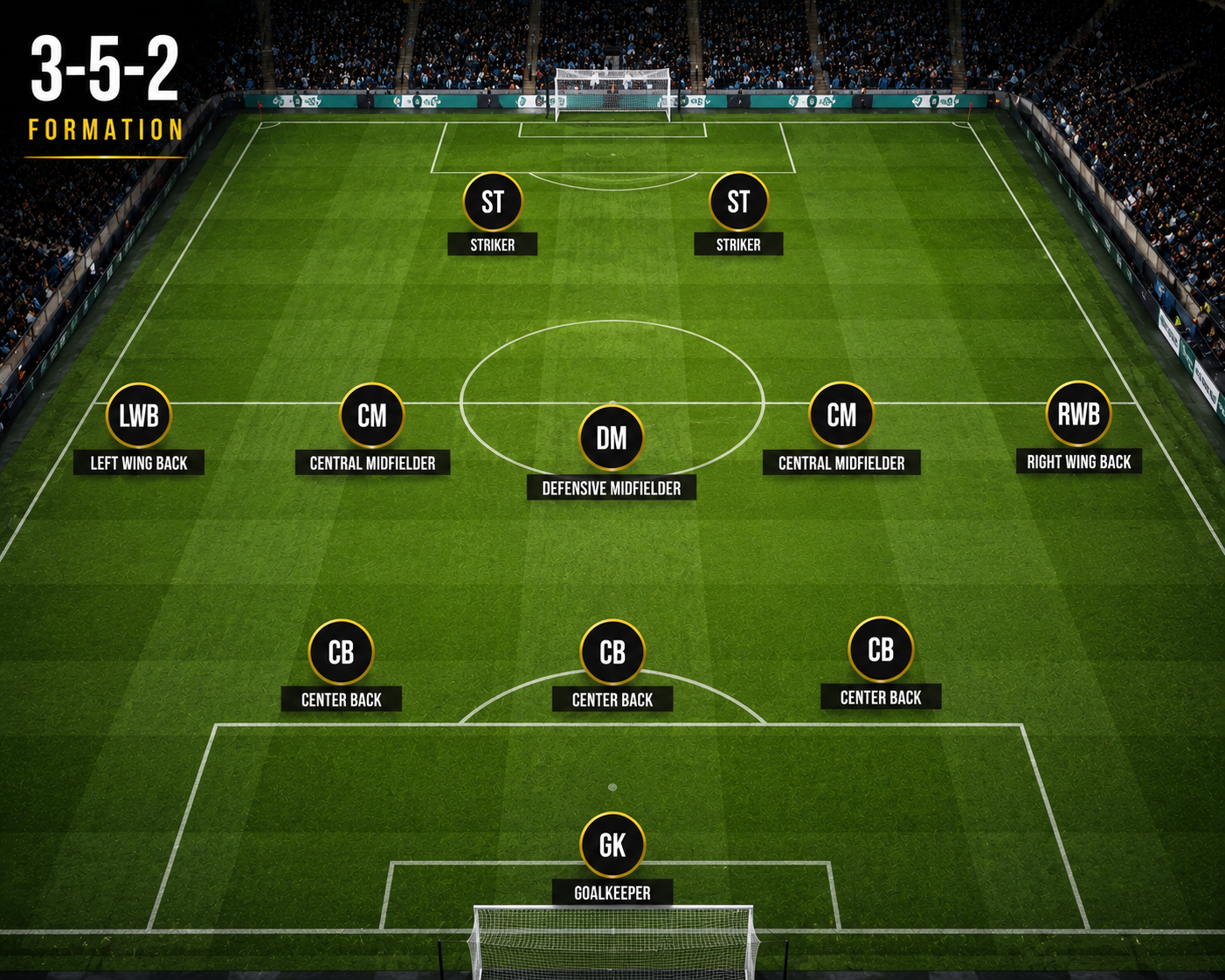
The 3-5-2 Formation: Dominating the Midfield
The 3-5-2 has become increasingly popular among managers who value tactical flexibility.
Instead of four defenders, teams use three centre-backs supported by two energetic wing-backs who operate almost like wingers when attacking.
Why Managers Choose It
The biggest strength of the 3-5-2 is midfield superiority.
With five midfield players, teams often control possession and make it difficult for opponents to play through the centre.
Having two strikers also creates constant problems for opposing defenders.
Wing-backs provide attacking width while the three centre-backs offer additional defensive security.
Weaknesses
●Everything depends on the wing-backs.
●If they fail to recover defensively, the team can become vulnerable down both flanks.
●The system also requires centre-backs who are comfortable carrying the ball forward and defending wide areas.
●Without disciplined players, the formation can quickly lose its shape.
Famous teams
●Inter Milan under Antonio Conte
●Italy under Roberto Mancini in selected matches
●Atalanta under Gian Piero Gasperini
●Juventus under Antonio Conte
Which Formation Is Best?
Credit: Sevens sports arena
There is no perfect football formation.
A system is only as effective as the players using it.
The 4-3-3 suits teams that dominate possession and attack relentlessly.
The 4-2-3-1 offers balance between defence and attack, making it one of the safest choices for most managers.
The 3-5-2 excels when a team has outstanding wing-backs and wants numerical superiority in midfield.
Ultimately, success depends less on the numbers on a tactics board and more on coaching, player intelligence, teamwork and execution.
That is why the world's best managers rarely stick rigidly to one formation. They adapt based on the opposition, injuries, player strengths and the demands of each match.
Modern Football Is More Than Numbers
Today's elite teams rarely remain in one shape for 90 minutes.
●Manchester City may begin in a 4-3-3 but attack with five forwards.
●Arsenal often defend in a 4-4-2 before switching to a 3-2-5 in possession.
●Inter Milan's 3-5-2 can become a back five without the ball or resemble a 3-2-5 when attacking.
The best teams understand that formations are starting points, not rigid instructions.
Managers now focus on controlling space rather than simply assigning positions.
As football continues to evolve, tactical flexibility has become just as important as technical ability.
Final Thoughts
Understanding football formations changes the way you watch the game.
Instead of simply following the ball, you begin to notice how teams create space, press opponents, overload key areas and exploit weaknesses.
Whether it's the attacking flair of the 4-3-3, the balance of the 4-2-3-1 or the tactical flexibility of the 3-5-2, every formation tells a different story.
No single system guarantees success, but choosing the right formation—and executing it well—can make the difference between winning trophies and falling short.
The next time you watch a match, pay attention not only to who scores but also to how each team is organised. You'll gain a deeper appreciation for the tactical chess match taking place beneath the surface.
Key Takeaways
●The 4-3-3 is ideal for attacking football and high pressing.
●The 4-2-3-1 provides excellent balance between defence and attack.
●The 3-5-2 dominates midfield and relies heavily on wing-backs.
●Modern formations are fluid and often change during matches.
Success depends on players, coaching and tactical discipline—not just the formation itself.
Fan Debate
●⚽ Goal: Which formation has been the most successful in modern football?
●🔥 Fire: Which current manager gets the best out of their tactical system?
●😲 Shock: Which formation do you think is the hardest to play against?
●👍 Like: If you enjoy football tactics and tactical analysis.
●💬 Comment: Which football tactic or formation would you like Sevens Sports Arena to explain next?
Did you enjoy this story?
Do well to save or bookmark it to have easy access to all Sevens Sports Arena has to offer
Comments (0)
No comments yet. Be the first to share your thoughts!